Most heart risk calculators work by estimation. They take your age, blood pressure, cholesterol, smoking status and diabetes, and produce a probability. It is a reasonable guess based on what happened to large groups of people who resembled you.
A coronary calcium score does something different. Instead of estimating what is probably happening inside your arteries, it looks.
What the scan measures
When plaque forms in a coronary artery and begins to harden, calcium is deposited in it. Calcium shows up brilliantly on a CT scan. So a short, non-contrast CT of the chest can find those deposits, measure their density and area, and add them up into a single number: the Agatston score.
The scan takes about ten minutes in total, of which the actual imaging is a few seconds. No injection, no dye, no treadmill, no fasting. You lie still, hold your breath once or twice, and walk out.
What your score means
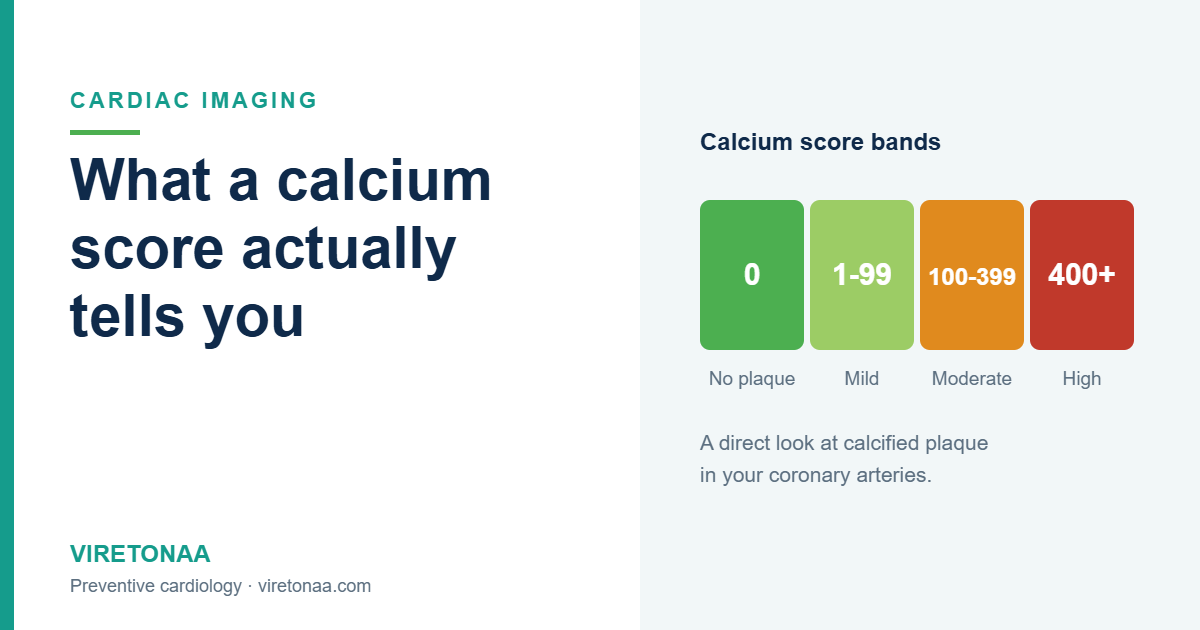
- 0 – no detectable calcified plaque. In most people this indicates a genuinely low short-term risk of a heart attack.
- 1 to 99 – mild plaque. Disease has started. This is the point at which prevention is most worthwhile.
- 100 to 399 – moderate plaque. Most guidelines would treat this as a reason to start or intensify cholesterol-lowering treatment.
- 400 and above – extensive plaque and high risk, warranting the same intensity of preventive treatment as many people who already have known heart disease. Above 1000, the event rate genuinely does approach that of someone being treated after a heart attack.
Your score is also usually reported as a percentile for your age and sex. A score of 90 means something quite different at 68 than it does at 42. A young person with any calcium at all is an outlier, and outliers deserve attention.
The most useful result is often zero
Patients tend to assume the value of the test is catching disease. Frequently the greater value is ruling it out.
If you are 55, moderately anxious about your family history, and your calculated risk sits in that uncomfortable middle band where a statin is neither clearly indicated nor clearly unnecessary, a score of zero shifts the balance. For most people in that middle band it means statin treatment can reasonably wait and be revisited in a few years, and a great many people are spared years of unnecessary medication on the strength of that one number. It does not mean the same thing for everyone. If you smoke, have diabetes, have familial hypercholesterolaemia or a very high LDL, or have a raised lipoprotein(a) or a strong family history of premature disease, a zero score lowers your risk but does not remove it, and treatment in those groups should not be decided on the calcium score alone.
The reverse is also true. A score of 300 in someone whose calculator said low risk changes the plan immediately, and usually changes how seriously that person takes it.
Who should consider it
The scan is designed for people with no symptoms whose risk is genuinely uncertain. Major guidelines point to:
- Adults roughly 40 to 75 years old at intermediate estimated risk, where the decision to start a statin is not clear-cut.
- Adults at lower estimated risk who have a strong family history of premature coronary disease.
- People who are reluctant to begin long-term medication and want objective evidence before deciding.
- People whose risk factors seem mild but who have a nagging sense that their family history says otherwise.
For South Asians this last group is larger than it looks, because standard risk calculators were built mainly on Western populations and can understate risk in Indian patients. We have written separately about why Indians develop heart disease earlier.
Who should not bother
This is not a test for everyone, and a good preventive cardiologist will talk some people out of it.
- If you have symptoms – chest pain, breathlessness on exertion, pain in the jaw or arm – the calcium score is the wrong test. You need proper evaluation now. Read the warning signs and what to do first.
- If you have already had a heart attack, stent or bypass, you are already being treated. Read your recovery plan instead.
- If you already know you need treatment – established diabetes with other risk factors, or very high LDL – the scan will not change what should be done.
- If you are under 40, calcium has usually not had time to accumulate, so a zero is less reassuring than it sounds.
The honest limitations
Calcium scoring measures hardened plaque. It does not see soft, non-calcified plaque, which is younger, more inflamed and in some ways more dangerous. This matters most in people under about 45, where a rupture-prone soft plaque can exist alongside a score of zero. A zero is reassuring, not a guarantee.
It also tells you nothing about whether an artery is narrowed enough to limit blood flow. A high score does not mean you need a stent. It means you need serious prevention.
And there is radiation, though the dose in a modern calcium scan is small, in the range of a mammogram. Once you have your score, you rarely need to repeat it, and certainly not annually. One thing to know if you do: statins increase the calcification of existing plaque, so a repeat score can rise even while your risk is falling. A higher number on treatment is not evidence that treatment has failed.
What you do with the number
A score on its own achieves nothing. What matters is what changes because of it.
If your score is above zero, you have radiographic proof of coronary artery disease, whatever your age and however well you feel. That usually means treating cholesterol to a firmer target, treating blood pressure properly, dealing with blood sugar, and stopping smoking without further negotiation. Our page on preventive cardiology sets out how those pieces fit together.
If your score is zero, you have earned a few years of reassurance, not permanent immunity. Risk factors keep accumulating quietly. The number to repeat is not the scan, it is the review.
Not sure whether you need one?
Start with our free heart risk assessment. It will tell you roughly where you sit, and whether a coronary calcium score is likely to change anything for you. If it is, our membership plans include the interpretation and the follow-up, which is the part that actually determines the outcome.
This article is general health education, not personal medical advice. Imaging decisions should be made with your own doctor. See our medical disclaimer.