A man of 48 walks into the emergency department with a heart attack. He does not smoke. His weight is reasonable. He had a full health check eighteen months ago and was told his cholesterol was normal. Everyone in the room, including him, wants to know the same thing: how did this happen?
Sometimes the answer is a particle his lipid profile never measured. It is called lipoprotein(a), usually written Lp(a) and pronounced L-P-little-a.
What Lipoprotein(a) actually is
Think of LDL, the particle you know as bad cholesterol. Lipoprotein(a) is an LDL particle carrying an extra passenger: a long, sticky protein called apolipoprotein(a) wrapped around it.
That extra protein changes the particle’s behaviour in three unhelpful ways. It deposits cholesterol into artery walls the way LDL does. It provokes inflammation inside the plaque that forms. And because its structure resembles a clotting protein, it interferes with the body’s ability to dissolve small clots. Plaque, inflammation and clotting are the three steps of a heart attack, and this one particle contributes to all three.
It is also linked to gradual narrowing of the aortic valve, which is why some people with high Lp(a) develop valve disease decades later with no other obvious cause.
Why your report does not have it
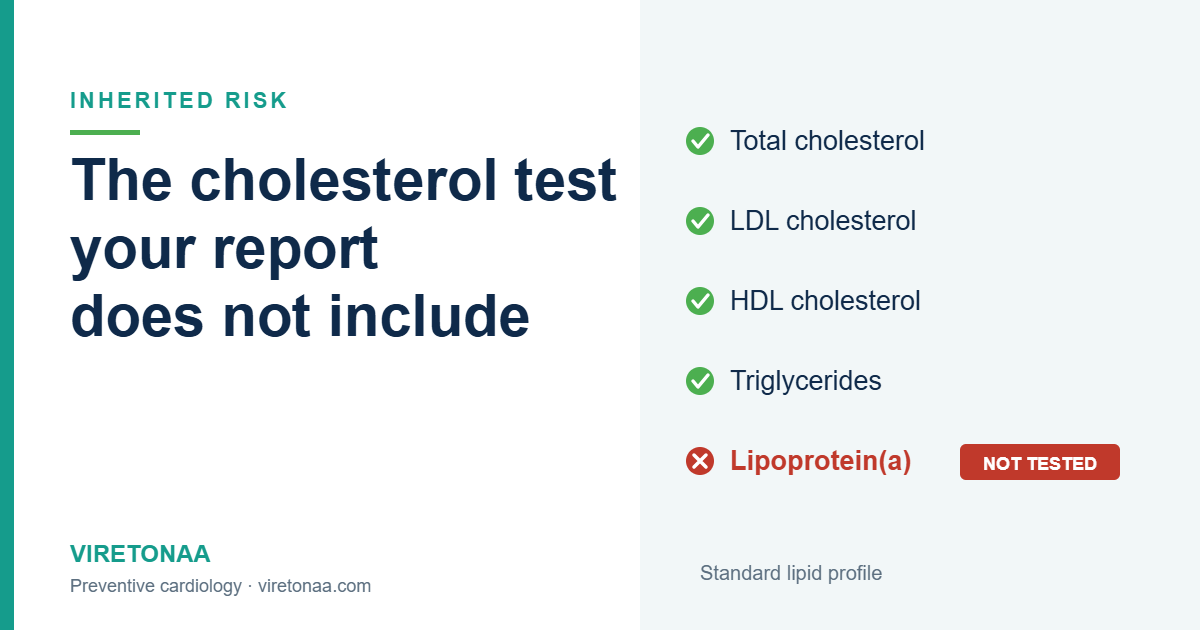
A standard lipid profile measures total cholesterol, LDL, HDL and triglycerides. Lipoprotein(a) is a separate test that has to be requested specifically. It is not part of any routine health package in India, so unless somebody asks for it, it does not get done.
There is a second reason it gets skipped. For years there was no drug that lowered it, so many doctors saw little point in measuring something they could not treat. That reasoning has aged badly, and we will come to why.
One test, once, for life
Here is the unusual thing about Lp(a): your level is set almost entirely by the genes you inherited from your parents. Diet barely moves it. Exercise barely moves it. Losing weight barely moves it. Statins, which are excellent at lowering LDL, do not lower Lp(a) and may raise it slightly.
That sounds like bad news, and in one sense it is. But it also means the level stays roughly stable across your adult life. You do not need to repeat this test every year. Major lipid societies now recommend that every adult have Lp(a) measured at least once in their lifetime, though not every guideline body has adopted this yet, so your doctor may take a more selective view. One blood sample, no fasting needed, and you have information you will use for the next forty years.
Reading the number
Lp(a) is reported either in nmol/L, which counts particles, or in mg/dL, which measures mass. Molar units are preferred, though Indian labs commonly report mg/dL. The two do not convert by a simple factor, so compare like with like.
Using the National Lipid Association’s thresholds:
- Below 75 nmol/L (about 30 mg/dL) – low risk.
- 75 to 125 nmol/L (about 30 to 50 mg/dL) – intermediate.
- 125 nmol/L or above (about 50 mg/dL or above) – high risk.
One caution the lipid societies themselves now emphasise: risk rises continuously with Lp(a) rather than in steps. There is no level at which it becomes irrelevant, and a result of 70 nmol/L is not the same as a result of 10, even though both fall in the same band. European guidance draws a similar line, treating a level above roughly 50 mg/dL as a factor that pushes overall cardiovascular risk upward. Around one in five people worldwide sits above that line, which makes this one of the most common inherited risk factors almost nobody has heard of.
Who should ask for this test
Ideally everyone, once. But if you recognise yourself below, it moves from useful to important:
- A parent or sibling who had a heart attack, stent, bypass or stroke early – before 55 in men, before 65 in women.
- Your own heart event at a young age, particularly if your other numbers looked unremarkable.
- A strong family history of very high cholesterol, or a diagnosis of familial hypercholesterolaemia.
- Further events despite well-controlled LDL on treatment.
- Narrowing of the aortic valve with no clear explanation.
Your Lp(a) is high. Now what?
This is where people expect to be told about a pill, and where the honest answer is different. Several drugs designed specifically to lower Lp(a) are in late-stage trials and they lower the level dramatically. What we do not yet have is published proof that lowering it prevents heart attacks. As of August 2026 the first large outcomes trial has not reported, and no Lp(a)-lowering drug is approved for that purpose. We will update this page when the results are published.
So the strategy is not to attack Lp(a) directly. It is to accept that you are carrying a fixed weight you cannot put down, and therefore to lighten every other load you can control.
- Drive LDL cholesterol lower than standard targets. Your doctor may aim well below the number that would satisfy someone else. Our page on cholesterol and lipids explains which numbers matter.
- Get blood pressure to target and keep it there. See what your two blood pressure numbers mean.
- Stop smoking completely. Nothing else on this list delivers as much benefit as quickly.
- Take diabetes and prediabetes seriously. Read how blood sugar quietly damages arteries.
- Ask about imaging. A coronary calcium score shows whether your arteries have actually accumulated plaque, which changes how aggressively you and your doctor act.
Tell your family
This is the part people forget. Lp(a) is inherited in a straightforward way, which means your children, your siblings and your parents each have a meaningful chance of carrying a similar level. A single high result in one person is a reason for the whole family to be tested. In practice, one blood test in one relative often prevents an event two decades later in another.
What a high result does not mean
It is not a diagnosis and it is not a prediction. It is a risk modifier. Most people with elevated Lp(a) will never have a heart attack, and plenty of people with normal Lp(a) do. What the number does is tell you and your doctor how hard to work on everything else, and how early to start.
That is the whole argument for measuring it. Not to frighten you, but to stop you being reassured by a normal-looking report that was never designed to look for this.
Where to start
If your family history worries you, begin with our free heart risk assessment. It takes a few minutes and tells you whether a lipoprotein(a) test and a wider workup are worth discussing with your doctor. If you would like that discussion to happen with a preventive cardiologist who follows your numbers over years rather than minutes, our membership plans are built for exactly that.
This article is general health education, not personal medical advice. Please discuss testing and treatment decisions with your own doctor. See our medical disclaimer.