Snoring is treated as a domestic nuisance. It is a subject for jokes, separate bedrooms and mild embarrassment. It is very rarely treated as what it sometimes is: a nightly, repeating cardiovascular stress test that your heart is failing.
What is happening while you sleep
In obstructive sleep apnoea, the soft tissues at the back of the throat relax during sleep and collapse inward, blocking the airway. Breathing stops. It may stop for ten seconds, or thirty, or longer. Oxygen levels in the blood fall.
The brain, sensing suffocation, triggers a brief arousal. You do not wake up properly and you will not remember it, but the body responds as though you are in danger: a surge of adrenaline, a jump in heart rate, a spike in blood pressure. The airway opens, often with a gasp or a loud snort, breathing resumes, and you sink back into sleep.
Then it happens again. In severe cases this cycle repeats thirty, fifty, even eighty times an hour, every hour, every night, for years.
Why the heart pays for it
Blood pressure that never comes down
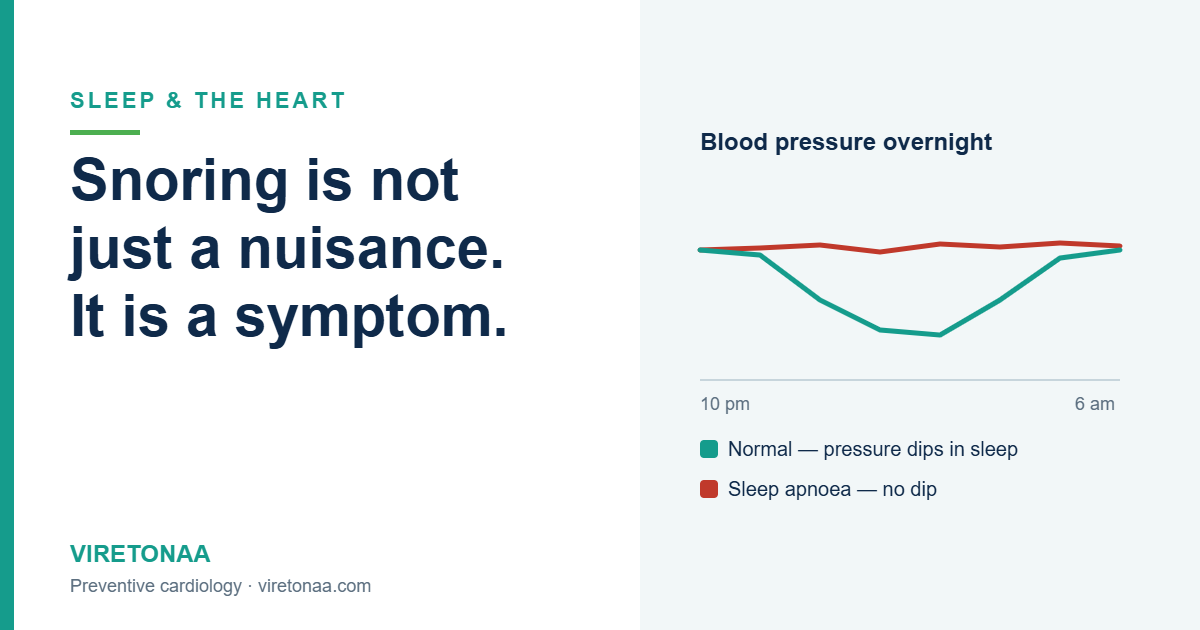
In healthy sleep, blood pressure falls by ten to twenty per cent overnight. This nocturnal dip gives the heart and arteries several hours of genuine rest. In sleep apnoea, the repeated adrenaline surges abolish that dip. Pressure stays elevated through the night.
This is the mechanism behind resistant hypertension – blood pressure that will not come to target despite three or more medications of different classes at full doses, one of which is a diuretic. If that describes you, untreated sleep apnoea is one of the first things worth excluding. Our page on blood pressure numbers explains what the targets are.
Rhythm disturbance
Repeated drops in oxygen, combined with pressure changes inside the chest and swings in the nervous system, irritate the upper chambers of the heart. Sleep apnoea is strikingly common in people with atrial fibrillation, and untreated apnoea makes AF both more likely to occur and more likely to return after treatment. If you have palpitations or a known rhythm problem, read our page on palpitations and arrhythmia.
Coronary disease and stroke
Meta-analyses link severe obstructive sleep apnoea – more than 30 breathing interruptions an hour – to roughly double the risk of stroke and of death from any cause, and about 1.8 times the risk of cardiovascular disease. The association is weaker for moderate apnoea and is not clearly established for mild apnoea, which matters when you read your own report. The nightly cycle of low oxygen and adrenaline promotes inflammation, endothelial dysfunction and insulin resistance – the same machinery that drives plaque formation.
Recognising it
The stereotype is a large, middle-aged man who snores. That stereotype causes missed diagnoses, because in Asian populations sleep apnoea occurs at lower body weights, often driven by facial and airway structure rather than weight alone. Slim people get it. Women get it, frequently with different symptoms.
Worth investigating if you have several of these:
- Loud, habitual snoring, particularly if a partner has noticed you stop breathing.
- Waking with a dry mouth, sore throat or headache.
- Waking unrefreshed after a full night’s sleep.
- Daytime sleepiness – nodding off while reading, watching television, in meetings or, most seriously, while driving. If you have fallen asleep or nearly fallen asleep at the wheel, stop driving until you have been assessed.
- Needing to pass urine more than once at night.
- Blood pressure that will not come to target.
- Atrial fibrillation, especially if it recurs after treatment.
- Difficult-to-control diabetes.
- Irritability, poor concentration or low mood without a clear cause.
Women more often report fatigue, insomnia, morning headache and low mood than classic loud snoring, which is a large part of why the condition is underdiagnosed in women. See also women’s heart health.
How it is tested
A home sleep study is the usual starting point. A small device records airflow, oxygen saturation, heart rate and chest movement while you sleep in your own bed. It is unglamorous but not uncomfortable, and for most people it is enough to make the diagnosis.
A full laboratory sleep study, where you spend a night in a sleep unit, is used where the picture is complicated or a home study is inconclusive.
The result is reported as an apnoea-hypopnoea index: the number of breathing interruptions per hour. Broadly, 5 to 15 is mild, 15 to 30 moderate, and above 30 severe. The oxygen data alongside it matters as much as the index itself.
Treatment, and the honest part about it
CPAP – a mask delivering gently pressurised air that holds the airway open – is the most effective treatment. It abolishes the breathing events, improves the overnight blood pressure profile and, for people with moderate to severe disease, transforms daytime function. Many patients describe the first week as the best sleep they have had in a decade.
It is also true that a substantial number of people cannot tolerate the mask and abandon it. That is worth saying plainly rather than discovering privately and feeling like a failure. Mask fit, humidification and pressure settings can almost always be adjusted, and it is worth persisting through the first month before concluding it will not work.
Other options, depending on severity and anatomy: mandibular advancement devices made by a dentist, positional therapy where events occur mainly on the back, weight reduction where relevant, and surgery in selected cases. Alcohol in the evening and sedative medication both worsen apnoea and are worth removing regardless.
The point
One point deserves honesty rather than salesmanship. The large randomised trials of CPAP have not shown a reduction in heart attacks and strokes, most probably because average nightly use in those trials was only three to four hours. Treating apnoea is clearly worth doing for symptoms, for blood pressure control and for rhythm stability. It does not replace treating cholesterol, blood pressure and blood sugar, and nobody should regard a CPAP machine as cardiac protection on its own.
If your blood pressure is stubborn, your rhythm is unreliable, or you are exhausted despite eight hours in bed, the explanation may not be in your chest at all. It may be in your airway, every night, unwitnessed.
Ask your partner what your breathing sounds like. It is a more useful cardiac question than it appears.
Next step
Our free heart risk assessment includes sleep and lifestyle questions alongside the usual risk factors. If sleep apnoea is contributing to your blood pressure or rhythm, our lifestyle coaching and membership plans can help you work through testing and treatment properly rather than in isolation.
This article is general health education, not personal medical advice. Sleep studies and treatment should be arranged through your own doctor. See our medical disclaimer.
Comments are closed.