Every few months a story circulates: someone in their forties collapses at the gym, or during a marathon, and the conclusion drawn is that intense exercise is dangerous after a certain age.
The conclusion is wrong, and it is dangerous in its own way, because it gives millions of sedentary people a reason to stay sedentary. But the story is not baseless either. There is a real risk, it sits in a specific and narrow window, and it is largely avoidable.
What the evidence actually shows
Regular moderate-to-vigorous activity is associated with roughly 20 to 30 per cent lower all-cause and cardiovascular mortality in large cohort studies, and the single largest gain comes from moving from doing nothing to doing something. For the population as a whole, the benefits of physical activity comfortably outweigh the acute risks, and regular exercisers have a lower risk of exercise-related heart attack, not a higher one.
The elevated risk during exertion is concentrated in the person who is unaccustomed to it. An unfit 46-year-old who plays a hard hour of badminton after fifteen years of nothing is in a different situation from someone who trains four times a week. The problem is not exercise. It is sudden, unaccustomed exertion in an unprepared body that may already have silent coronary disease.
What is actually happening in those cases
In adults over about 35, the overwhelming cause of exercise-related cardiac arrest is coronary artery disease that nobody knew was there. Plaque that had been sitting quietly ruptures under the haemodynamic stress of unaccustomed exertion, a clot forms, and an artery closes.
This is the important point for Indian readers: that plaque is present a decade earlier here than in Western populations. A 42-year-old Indian man returning to fitness is, statistically, in the position of a 52-year-old European. Our article on why Indians develop heart disease earlier explains why.
Who should get checked before starting
Not everybody needs a stress test to start walking. Screening should be proportionate.
Go ahead, sensibly
If you are under 40, have no symptoms, no known heart disease, and none of the risk factors listed below – high blood pressure, diabetes or prediabetes, high cholesterol, current or past smoking, obesity, or a family history of premature cardiac death – you can begin a gradual programme without formal testing. Because coronary disease appears a decade earlier in Indians, treat 35 rather than 40 as the age at which that list is worth checking properly.
See a doctor first
- You are 40 or over and intend to train vigorously rather than gently.
- You have any risk factor – high blood pressure, diabetes or prediabetes, high cholesterol, current or past smoking, obesity.
- A first-degree relative had a heart attack or sudden death before 55 in men or 65 in women.
- You have been entirely sedentary for years and plan to make a significant jump.
- You are already known to have heart disease of any kind.
See a doctor before you exercise again, without exception
If you have ever experienced chest tightness or pressure on exertion, breathlessness disproportionate to the effort, dizziness or blackout during or straight after exercise, or palpitations with light-headedness – stop and get assessed before you train again. These are the symptoms that precede events, and they are routinely explained away as being unfit or out of practice. Read the warning signs.
What a pre-exercise check involves
Usually less than people fear. A careful history, including family history, and an examination. Blood pressure. An ECG. Bloods for lipids and glucose. From that, an estimate of your cardiovascular risk.
An exercise stress test is added where risk is meaningful or symptoms are present, and it has a second benefit: it tells you what your heart and blood pressure do under load, which lets your training zones be set from your own physiology rather than a formula. Where the picture is uncertain, a coronary calcium score can show whether plaque is present at all.
How to build up without incident
- Give yourself six weeks of base before anything hard. Brisk walking, easy cycling, swimming. If you cannot hold a conversation, you are going too fast for this phase.
- Warm up for ten minutes, every session. The transition from rest to hard effort is where events cluster. Ease into it.
- Increase by roughly ten per cent a week, and change only one variable at a time – duration or intensity, not both.
- Cool down properly. Stopping abruptly after hard effort drops blood pressure sharply. Walk it off for five minutes.
- Add resistance training twice a week. For South Asians in particular, muscle mass improves insulin sensitivity and is not a cosmetic concern.
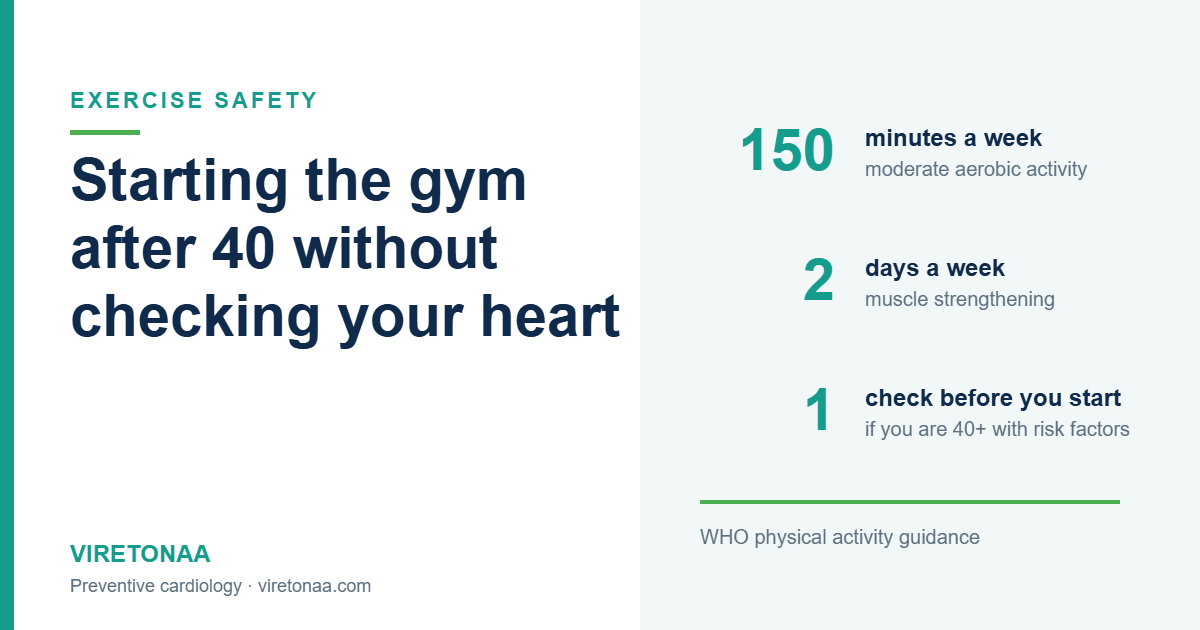
- Aim for 150 to 300 minutes of moderate activity a week, or 75 to 150 minutes of vigorous activity, plus strength work on two days. That is the WHO range. The lower end is a floor, not a target.
Signals to stop immediately
Learn these, and treat them as instructions rather than suggestions. If you develop chest pressure, tightness or pain, a cold sweat with nausea, or pain spreading to the jaw, neck or arm during exertion, stop immediately, do not drive yourself anywhere, and call emergency services on 108. That combination during exercise is a heart attack until proven otherwise. For unusual breathlessness for the effort involved, light-headedness or feeling faint, or palpitations with dizziness that settle with rest, stop for the day and arrange a medical assessment before your next session.
The instinct to push through is admirable in almost every other context and misplaced here.
Some practical points
Take your medications as prescribed, including on training days – blood pressure tablets in particular. If you are on beta blockers your heart rate will not rise as expected, so use perceived exertion rather than a heart rate formula. Read our page on what each heart medicine does.
Be careful in Indian summer heat: train early or late, and drink adequately. And be honest with the trainer at your gym about your medical history. Most are competent at programming and are not equipped to guess at cardiac risk you have not disclosed.
The balance
The risk of exercising after 40 is small, concentrated in the untrained and the unscreened, and reducible by a single medical review and a sensible six-week build-up. None of this should stop you going for a walk today while you arrange that review.
The risk of not exercising is large, certain and cumulative. Do not let a headline about somebody else’s collapse become the reason you never start.
Before your first session
Take our free heart risk assessment to see whether you need a formal check before training. If you would like a programme built around your own numbers rather than a generic template, our lifestyle coaching and membership plans are designed for that.
This article is general health education, not personal medical advice. Please seek an individual assessment before beginning vigorous exercise. See our medical disclaimer.