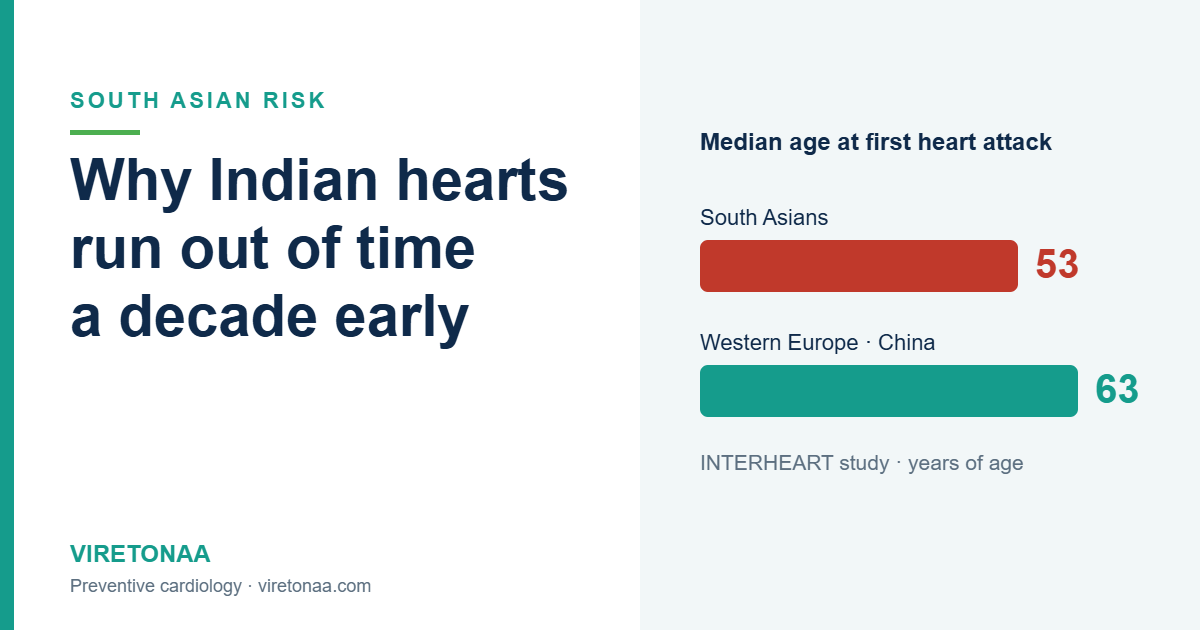
There is a number that should be better known in this country than it is. In the INTERHEART study, which examined heart attack patients across 52 countries, the median age of a first heart attack in South Asians was 53. In Western Europe, China and Hong Kong it was 63.
Ten years. Not ten years of extra symptoms, but ten years of life taken off the front of the curve, typically during the decade when people are supporting children through education and parents through old age.
What the risk factor data actually shows
Some of the gap is straightforward. Rates of diabetes and smoking are high, and both arrived earlier in life here than in most Western populations. Abdominal obesity is common even in people whose overall weight looks acceptable. Physical activity has fallen sharply in a single generation.
Here the data is more encouraging than most people expect. In INTERHEART, the nine conventional risk factors accounted for around 86 per cent of the risk of a first heart attack in South Asians – much the same proportion as in the rest of the world. The investigators concluded that the earlier age of heart attack in South Asians could largely be explained by those risk factors being present, and at higher levels, at younger ages. In other words, the drivers are mostly measurable and mostly modifiable. The open question is not what is causing this, but why it starts so early.
Why the risk factors arrive so early
Fat sits in the wrong places
South Asians tend to carry more visceral fat – the fat packed around the liver, pancreas and intestines – and less muscle at any given body weight. Visceral fat is metabolically noisy. It drives insulin resistance and inflammation in a way that fat under the skin does not.
This is why a man with a BMI of 24 and a waist of 96 cm can be at real risk while appearing, to himself and to everyone else, perfectly fine. Waist measurement is more informative here than weight, and the thresholds for Indians are lower than the international ones: broadly above 90 cm for men and 80 cm for women.
Insulin resistance starts young
Type 2 diabetes commonly appears a decade earlier in Indians than in Europeans, and often at a lower body weight. The years of prediabetes that precede it are not neutral. Arteries are being damaged throughout that period, silently, while blood sugar reports still read normal or borderline. Our page on diabetes and the heart covers what happens during those years.
The lipid pattern is different
The classic South Asian lipid profile is not dramatically high LDL. It is low HDL, high triglycerides, and a high number of apolipoprotein B-containing particles, often small and dense. A report can look almost acceptable while describing a distinctly atherogenic picture. In INTERHEART, the ratio of apolipoprotein B to apolipoprotein A1 was one of the strongest predictors of heart attack in South Asians, which is a technical way of saying the balance of particles mattered more than the headline cholesterol number.
Inherited factors we do not routinely measure
Elevated lipoprotein(a) is common in South Asian populations and is almost never tested for. It is inherited, it is not modifiable by lifestyle, and it contributes to plaque, inflammation and clotting all at once. We have written a full explanation of lipoprotein(a) and why your report does not include it.
Risk calculators quietly understate your risk
Most cardiovascular risk scores in routine use were developed and validated in largely European or American populations. Applied to an Indian patient, they can return a comfortable-looking number for someone whose actual biology is anything but comfortable.
This has a practical consequence. A 46-year-old Indian man may be told his ten-year risk is low, receive no treatment, and have an event at 52. He was not unlucky. He was measured with the wrong ruler.
This is why objective testing matters more here than the calculator alone. A coronary calcium score looks directly at the arteries rather than estimating from a population average.
What actually changes the trajectory
None of this is destiny. The gap is large, but almost every contributor to it responds to action taken early.
- Start screening by 30 at the latest, sooner with a family history. Guidelines already support a first lipid profile in your twenties. If the disease arrives a decade earlier here, surveillance has to begin a decade earlier too. Lipids, fasting glucose or HbA1c, blood pressure and waist circumference. Once, then repeat.
- Measure your waist, not just your weight. Use the Indian thresholds, not the international ones.
- Treat prediabetes as a cardiac diagnosis, because that is functionally what it is.
- Look at the whole lipid picture – triglycerides, HDL and, where available, apolipoprotein B – not only LDL. See cholesterol and lipids.
- Build muscle deliberately. Given the low muscle mass pattern, resistance training is not optional here; it improves insulin sensitivity directly.
- Fix the carbohydrate load before anything else in the diet. Our guide to the Indian diet and your heart deals with rice, roti, oils and snacks specifically.
A word to families
If a parent or sibling had a heart attack before 55 in men or 65 in women, you are not simply someone with a family history to mention in passing. You belong to a higher-risk group, and the appropriate response is earlier screening and a lower threshold for testing, not reassurance.
The uncomfortable truth of the ten-year gap is that it removes the margin for waiting. In a population where events cluster in the fifties, prevention that starts at 50 has largely missed its window. Started at 35, it changes everything.
Find out where you stand
Our free heart risk assessment takes a few minutes and is written with Indian risk patterns in mind. If you would rather have your numbers tracked properly over time, with someone watching the trend rather than a single reading, look at our membership plans.
This article is general health education, not personal medical advice. Please discuss your own risk and testing with your doctor. See our medical disclaimer.